
What Are the Stages of Sleep?
Date Published
Aug 17, 2026Time to Read
7 min
Sleep is scored in four stages: three non-REM stages named N1, N2 and N3, plus REM sleep, read in 30-second epochs from brain, eye and muscle activity. Those stages don't climb a staircase from light to deep and back again. They repeat in cycles whose internal mix changes as the night goes on, with slow wave activity concentrated in the early hours and REM concentrated in the later ones.
Key Takeaways
- Sleep scoring recognizes four stages, N1, N2, N3 and REM, and the older habit of splitting deep sleep into stages 3 and 4 was dropped when no evidence was found to justify the division.
- A night is a sequence of NREM and REM cycles rather than a single descent, and early cycles carry more slow wave activity while later ones carry more REM.
- Sleep is conventionally described as 4 to 5 cycles of about 90 minutes, but cycle count and cycle duration are normally distributed variables, so that figure is the middle of a spread rather than a fixed unit.
Where the stage names actually come from
The stage names in your sleep report come from a scoring standard. Not from anything the brain announces.
When the American Academy of Sleep Medicine reworked visual sleep scoring, the task force recommended three EEG derivations, two channels of eye movement recording and one of chin muscle activity, kept the practice of scoring in 30-second epochs, and proposed the stage terminology now in use (Silber et al., 2007).
One detail from that review still shapes how your sleep report reads. Deep sleep used to be reported as two separate stages. Actually, the task force found no evidence to justify dividing slow wave sleep in two, which is why a single N3 replaced the old stages 3 and 4.
So a stage is a label. It gets applied to a 30-second window, based on which signature dominates that window. Half a minute at a time, and a night is roughly a thousand of them strung together. That's the resolution everything else here is built on.
REM vs deep sleep: two systems, not two depths
N3 is the stage defined by high-amplitude slow waves, and its intensity isn't constant across a night. That pattern is the clearest signature of sleep's homeostatic side. Slow wave activity is high at the start of the sleep period and then declines, and in humans that decline is exponential, which is the observation the two-process model was built on: a sleep-wake dependent homeostatic process interacting with a process driven by the circadian pacemaker (Borbély, 2022).
REM is defined by a different cluster of features, principally rapid eye movements alongside low chin muscle tone, with its own rules for when an episode begins and ends. It also answers to the clock in a way slow wave sleep doesn't. In eight men living for 33–36 days on a 28-hour rest and activity schedule, REM sleep showed a robust circadian rhythm whose crest sat shortly after the core body temperature minimum, while slow wave activity carried only a low-amplitude circadian modulation (Dijk & Czeisler, 1995).
Put those two findings side by side and the staircase picture stops working. One stage tracks how long you've been awake. The other tracks where you are on your internal clock. They aren't the shallow end and the deep end of one scale. They're two processes answering to different signals, and that's why they sit in different parts of the night.
Why the second half of the night isn't the first half repeated
Slow wave activity front-loads. In a population-based cohort of 945 polysomnography studies, the slope of slow waves decreased from the first to the last hour of NREM sleep in every group except those with severe obstructive sleep apnea, and slow wave activity decayed across successive NREM episodes (Maganti et al., 2026). If you're trying to work out what your own share of that early deep sleep means, how much deep sleep you actually need is the better place to start.
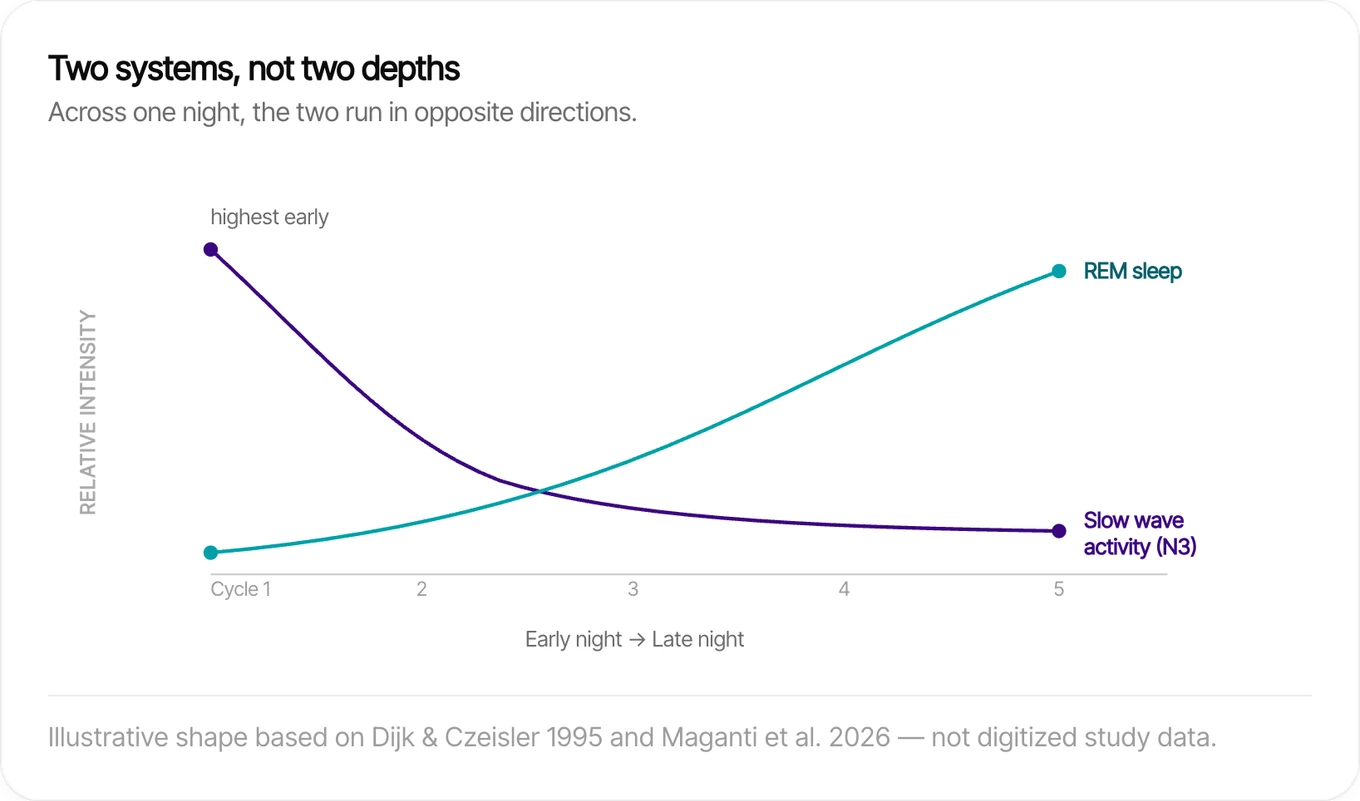
REM does the opposite. In the forced desynchrony data above, REM rose both with time already spent asleep and with circadian phase, so the highest REM values appeared when sleep episodes ended near habitual wake time (Dijk & Czeisler, 1995). That makes the back half of the night the REM-intensive half. So the same total sleep time can deliver very different amounts of REM, depending on where it got cut short.
This is the part a stage percentage can't show you. Your stage mix at 6 am isn't just cycle number five. It's cycle number five at that point on your internal clock, and only one of those two facts survives into a summary.
How long is one cycle, and why 90 minutes is only the middle
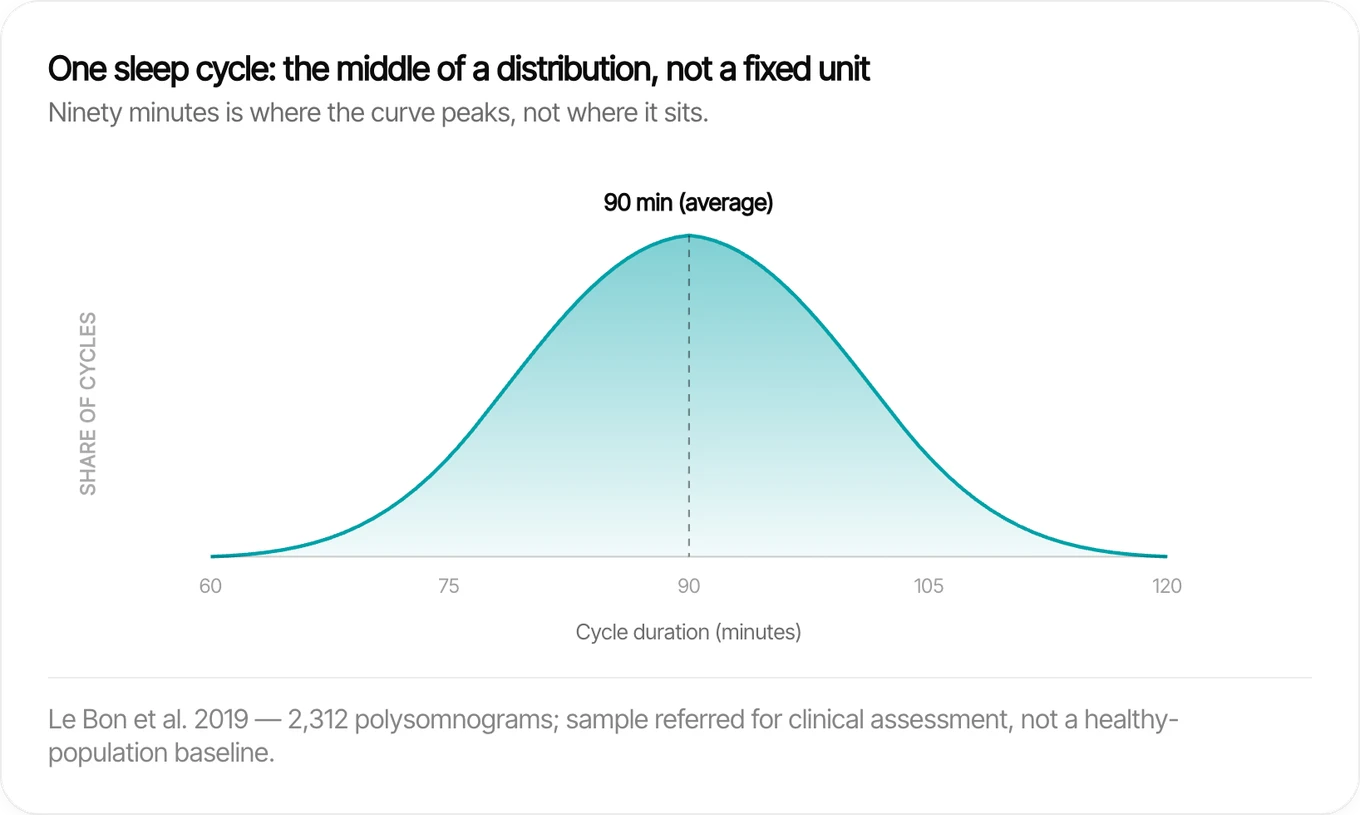
The conventional figure is specific. Sleep is usually described as 4 to 5 alternations between NREM and REM sleep per night, each running about 90 minutes (Le Bon et al., 2019). If you've ever counted backward from an alarm in 90-minute blocks, that's the figure you were using. It isn't wrong. It's just the center of a distribution, and the distribution is what gets dropped when the number travels on its own.
The same paper looked at that spread. In a retrospective analysis of polysomnograms from 2,312 unmedicated adults, both the number of cycles per night and the mean cycle duration were confirmed to follow a normal distribution, with Q-Q plots close to linearity. A normal distribution is the important detail: it means a central value with real spread on both sides of it, so 90 minutes is the peak of a curve rather than a unit of time your brain keeps. Note the sample. These were patients referred for medical or psychiatric assessment, not a healthy cohort.
Cycles also aren't interchangeable units. A first cycle and a fourth cycle have different contents, which means counting them tells you less than reading them.
The staircase is a neat picture, and it's the reason the alarm arithmetic feels so plausible: five clean flights of 90 minutes, so set the alarm at the top of one and you'll come up easily. What the data describe is looser. A curve with real width on both sides, and cycles whose contents change as the night goes on, so a boundary you worked out last Tuesday isn't holding a place for you tonight. The readable part of a night was never where the cycles ended. It's whether the deep sleep still arrived early, whether the REM still filled out toward morning, and how that shape sits against the shape your own weeks have established. That last comparison is what HaloScore builds, instead of a target lifted from a chart.
References
- Silber MH, Ancoli-Israel S, Bonnet MH, et al. The visual scoring of sleep in adults. Journal of Clinical Sleep Medicine. 2007;3(2):121–131. PMID: 17557422. (foundational: the AASM Visual Scoring Task Force report that established the current stage terminology; no DOI assigned)
- Borbély A. The two-process model of sleep regulation: beginnings and outlook. Journal of Sleep Research. 2022;31(4):e13598. PMID: 35502706. doi:10.1111/jsr.13598
- Dijk DJ, Czeisler CA. Contribution of the circadian pacemaker and the sleep homeostat to sleep propensity, sleep structure, electroencephalographic slow waves, and sleep spindle activity in humans. Journal of Neuroscience. 1995;15(5 Pt 1):3526–3538. PMID: 7751928. doi:10.1523/JNEUROSCI.15-05-03526.1995 (foundational: forced desynchrony designs of this kind have not been repeated at larger scale)
- Maganti R, Wang J, Hetzel S. Sleep homeostasis impairment across obstructive sleep apnea severity: findings from a population-based cohort study. Journal of Clinical Sleep Medicine. 2026;22(1):134. PMID: 42552458. doi:10.1007/s44470-026-00131-6
- Le Bon O, Lanquart JP, Hein M, Loas G. Sleep ultradian cycling: statistical distribution and links with other sleep variables, depression, insomnia and sleepiness. A retrospective study on 2,312 polysomnograms. Psychiatry Research. 2019;279:140–147. PMID: 30819535. doi:10.1016/j.psychres.2018.12.141
Related reading
- How Much Deep Sleep Do You Need?
There is no single target percentage for deep sleep. Your share shifts with age and swings night to night, so your own range tells you more than a chart.
- Why Do I Wake Up at 3am Every Night?
Brief awakenings at night are a normal part of sleep architecture. Here is why they cluster in the small hours and what returning to sleep depends on.
- Why Do I Feel Tired After Eight Hours of Sleep?
Eight hours in bed is not eight hours of continuous sleep. Fragmentation and irregular timing change how the same amount of sleep feels in the morning.