
Naps can do both. In laboratory studies, naps of 10 to 60 minutes were followed by better mood and less sleepiness for up to four hours, while a long nap taken every day shortened the following night in a small study of older adults. Which way it goes depends mainly on how long the nap runs and when it happens. A nap draws on the same sleep pressure your night uses, so it can move part of your night rather than simply add to it.
Key Takeaways
- A nap discharges part of the pressure to sleep that builds while you are awake, which is why the same nap can raise afternoon alertness and lighten the night that follows.
- In a meta-analysis of 11 laboratory-based studies covering 381 working-aged adults, cognitive performance improved after a nap, most clearly for alertness, and nap duration did not predict the size of the effect.
- Naps of 30 and 60 minutes were followed by sleep inertia, a short spell of grogginess, which cleared within 30 minutes in one randomized laboratory study.
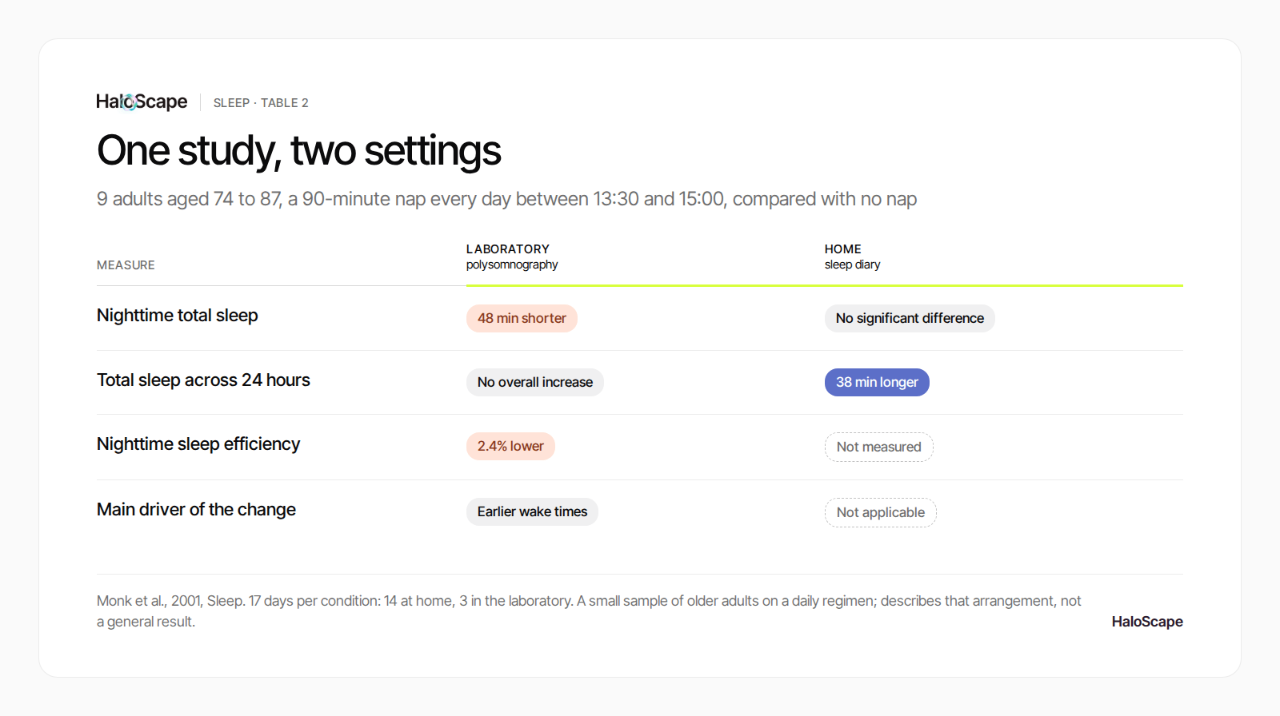
- In nine healthy adults aged 74 to 87 taking a 90-minute nap every day between 13:30 and 15:00, laboratory recordings showed 48 minutes less nighttime sleep. At-home diaries in the same study showed no difference in nighttime sleep and more total sleep across 24 hours.
How a nap borrows from the night ahead
The usual framing calls a nap extra sleep added to the day. In practice, it is often sleep moved within the day.
Pressure to sleep builds the longer you stay awake and discharges once you sleep, and a circadian process sets when that pressure is easiest to act on (Borbély et al., 2016). A nap discharges part of that pressure before the night starts. The night then begins from a lower point. If you have ever come out of a solid afternoon nap and then lain awake at your usual bedtime, you have already met that mechanism from the inside.
Fifty-seven adolescents aged 15 to 19 went through a 15-day protocol of sleep restriction and recovery, with time in bed held at 5 hours on the restricted nights. They were randomly assigned to a nap or a no-nap group, and the nap group got a one-hour nap opportunity at 14:00 after each restricted night. On those restriction nights, the nap group showed longer N2 latency and reduced total sleep time, sleep efficiency and slow-wave energy, which the authors read as reduced homeostatic sleep pressure (Ong et al., 2017). That is a nap against no nap inside a week of curtailed sleep, not a nap against an unrestricted night. The nap helped. Residual changes in the sleep EEG still led the authors to conclude that there is no substitute for adequate nighttime sleep. For what those stages are, see What Are the Stages of Sleep?
What happened when nap lengths went head to head
Everyone seems to have a number. The research is less certain.
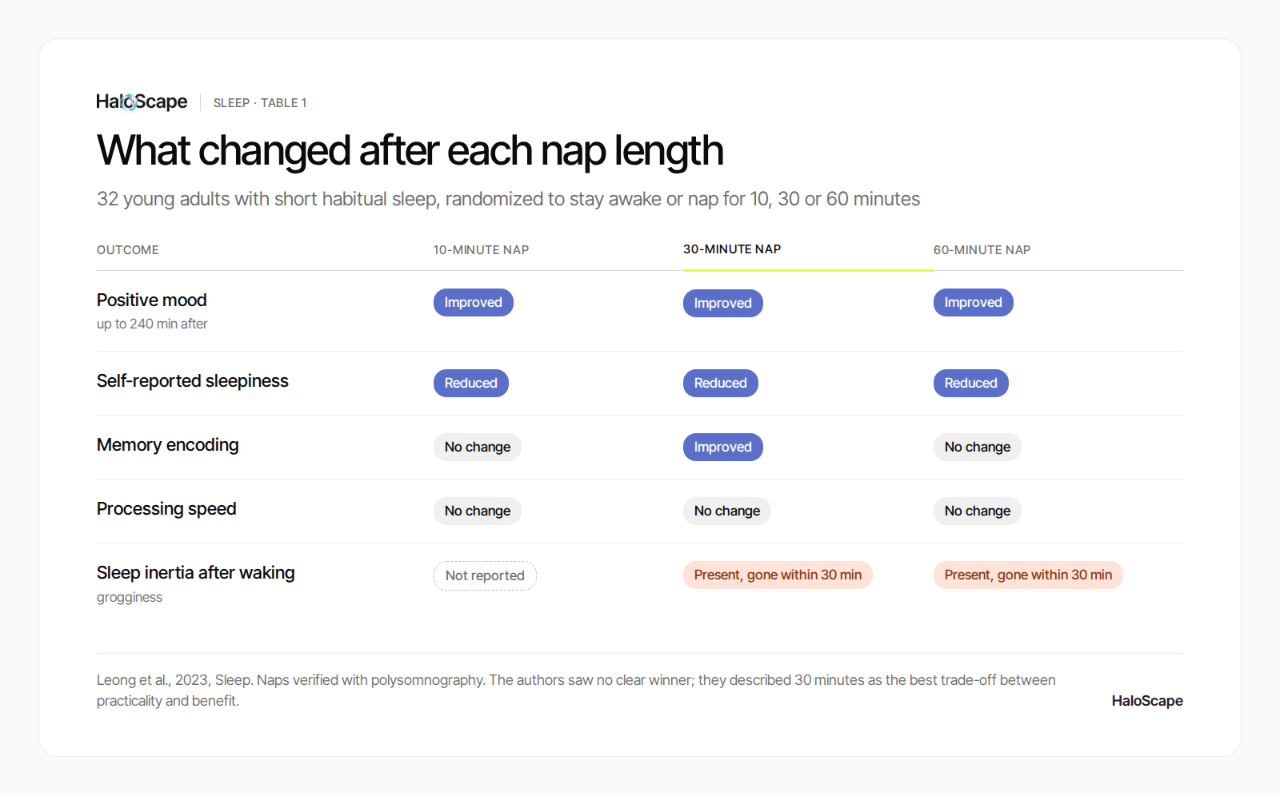
The most direct test put nap lengths against each other. Thirty-two young adults with short habitual sleep completed four randomized laboratory conditions: staying awake, and polysomnography-verified naps of 10, 30 and 60 minutes (Leong et al., 2023). All three nap lengths raised positive mood and reduced self-reported sleepiness for as long as 240 minutes afterward. Only the 30-minute nap improved memory encoding. The 30- and 60-minute naps were followed by sleep inertia, the groggy spell after waking, which resolved within 30 minutes. The authors found no clear winning duration, though they described a 30-minute nap as offering the best trade-off between practicality and benefit.
Pooled data point the same way. Across 11 studies covering 381 working-aged adults, all run in laboratory conditions (one with a subgroup in working conditions), cognitive performance improved after a nap with an effect size of 0.18 (95 percent CI 0.09 to 0.27), largest for alertness at 0.29 (95 percent CI 0.10 to 0.48) (Dutheil et al., 2021). Mean nap duration was 55.4 plus or minus 29.4 minutes, performance mainly improved for up to 120 minutes afterward, and nap duration did not influence the size of the effect. Short and long naps both bought alertness in these samples, in a window of roughly two hours rather than all day. A single correct length is not what these data show.
Does napping affect your night sleep?
It can. The clearest recordings come from repeated schedules, not single afternoons.
Nine healthy adults aged 74 to 87 completed both a nap and a no-nap condition, each lasting 17 days, 14 at home and 3 in the laboratory, with a 90-minute nap enforced every day between 13:30 and 15:00 (Monk et al., 2001). In the laboratory recordings, nighttime sleep efficiency fell by 2.4 percent and nighttime total sleep time fell by 48 minutes in the nap condition, driven mainly by significantly earlier wake times. At home, the picture was different: sleep diaries showed no significant difference in nighttime sleep, and total sleep across 24 hours rose by 38 minutes once the nap was counted. On a single evening test of how quickly people fell asleep when given the chance, the Multiple Sleep Latency Test, it took 15.6 minutes after nap days against 11.5 minutes without, a sign of lower evening sleepiness. Less sleepy in the evening. Shorter nights in the laboratory anyway. Nine older adults on a daily regimen is a narrow base, so read it as a description of that arrangement, not a general result.
Notice what the two lighter-night findings have in common. Both used early afternoon naps: 13:30 to 15:00 in the older adults, 14:00 in the adolescents on the restriction protocol. In these two studies, an early hour alone did not protect the night. What thinned the night in both cases was a long nap on a repeated or sleep-restricted schedule, not a late one.
Why the hour is harder to pin down than the length
Timing has been tracked, mostly outside the laboratory. Among 153 adolescents with a mean age of 16.6 years followed by sleep diary and actigraphy, naps averaged 82.12 plus or minus 53.34 minutes with a mean onset at 14:58. On school days, napping longer than their own average shortened nighttime sleep. On weekends, waking from a nap later than their own average delayed bedtime. The authors concluded that naps may be detrimental to the same night's sleep only if they are long and occur late (Leong et al., 2024). Long and late. Not either one on its own.
Read that for what it is: diary and actigraphy rather than polysomnography, observational, limited to teens who napped at least sometimes, and unable to separate the hour from the length. The meta-analysis adds one more hint, that naps taken before 1 p.m. were associated with somewhat better performance afterward, but the confidence interval for that estimate included no effect (0.24, 95 percent CI −0.07 to 0.34) (Dutheil et al., 2021). The timing evidence is thinner than the duration evidence, and what it describes is a shifted bedtime rather than an altered sleep architecture. If you nap and then watch your bedtime drift later, that is the pattern those diaries picked up. A night that starts late but runs a normal length is part of why a full night can still leave you tired. Night waking has its own pattern, covered in Why Do I Wake Up at 3am Every Night?
So the informative question is not which nap length is correct. It is what your own naps do to your own nights: how long it takes you to fall asleep and when you wake after nap days, compared with days without one, which your HaloScore sleep view can help you track.
People have argued about whether naps are good or bad for a long time, and the research keeps declining the question in those terms. It answers in two variables instead: how long, and when. Neither of those gets settled by a rule you read somewhere. Both of them show up in your own night, on the days you nap set beside the days you don't.
References
Borbély AA, Daan S, Wirz-Justice A, Deboer T. The two-process model of sleep regulation: a reappraisal. J Sleep Res. 2016;25(2):131-43. PMID: 26762182. doi:10.1111/jsr.12371
Ong JL, Lo JC, Gooley JJ, Chee MWL. EEG Changes Accompanying Successive Cycles of Sleep Restriction With and Without Naps in Adolescents. Sleep. 2017;40(4):zsx030. PMID: 28329386. doi:10.1093/sleep/zsx030
Leong RLF, Lau T, Dicom AR, Teo TB, Ong JL, Chee MWL. Influence of mid-afternoon nap duration and sleep parameters on memory encoding, mood, processing speed, and vigilance. Sleep. 2023;46(4):zsad025. PMID: 36775965. doi:10.1093/sleep/zsad025
Dutheil F, Danini B, Bagheri R, Fantini ML, Pereira B, Moustafa F, Trousselard M, Navel V. Effects of a Short Daytime Nap on the Cognitive Performance: A Systematic Review and Meta-Analysis. Int J Environ Res Public Health. 2021;18(19):10212. PMID: 34639511. doi:10.3390/ijerph181910212
Monk TH, Buysse DJ, Carrier J, Billy BD, Rose LR. Effects of afternoon "siesta" naps on sleep, alertness, performance, and circadian rhythms in the elderly. Sleep. 2001;24(6):680-7. PMID: 11560181. doi:10.1093/sleep/24.6.680
Leong RLF, Tian L, Yu N, Teo TB, Ong JL, Chee MWL. Bidirectional associations between the duration and timing of nocturnal sleep and daytime naps in adolescents differ from weekdays to weekends. Sleep. 2024;47(9):zsae147. PMID: 38938171. doi:10.1093/sleep/zsae147