

Partly, and it depends on which part of you is catching up. In laboratory studies, how sleepy and fatigued people felt often returned to baseline after one long recovery night, while sustained attention was still short of baseline after four, and in one small study nine, recovery nights. Weekend recovery sleep also did not prevent the drop in insulin sensitivity that came with the next run of short nights. That split is why weekend recovery sleep does not work as a substitute for a consistent schedule.
Key Takeaways
Recovery is marker-specific rather than global, so a recovery night can restore how alert you feel without restoring how well you actually perform.
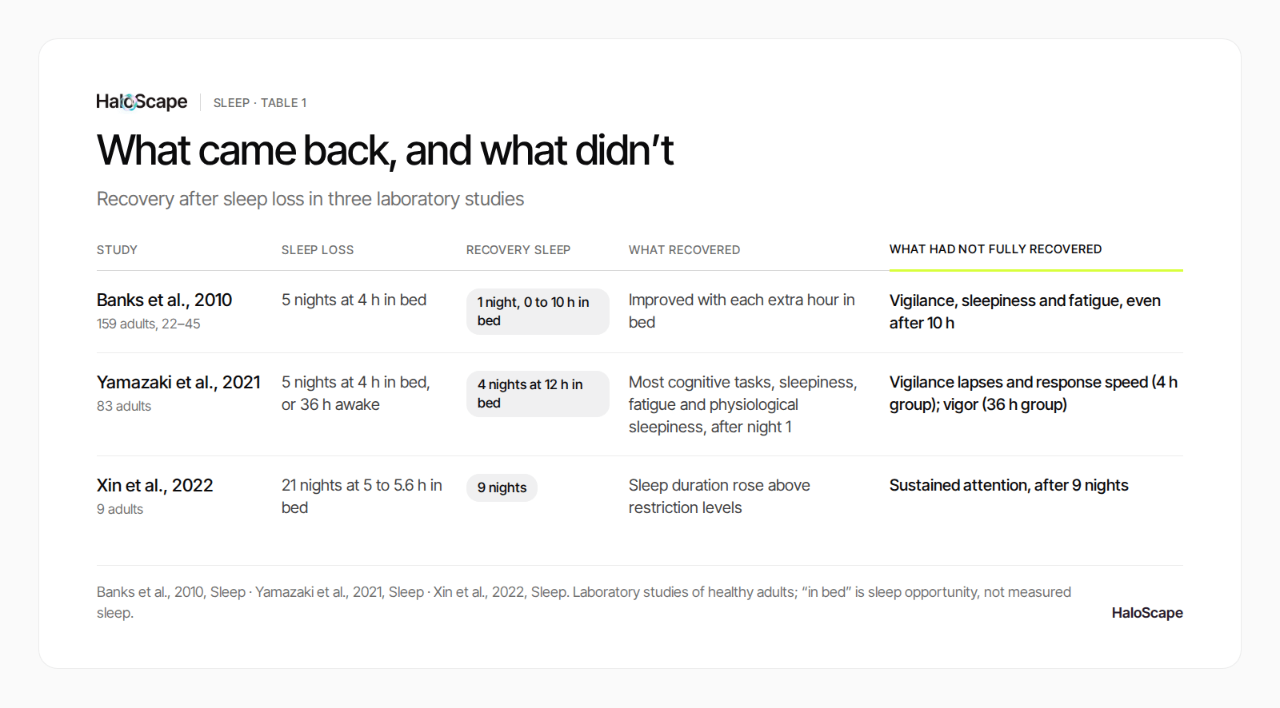
In a randomized laboratory study of 159 healthy adults aged 22–45, one recovery night of up to 10 hours in bed (about 9 hours of actual sleep) after five nights of 4-hour sleep restriction left vigilance performance, sleepiness and fatigue still short of baseline.
With longer recovery, 12 hours in bed for four nights, self-reported sleepiness and fatigue recovered after the first night, but lapses in sustained attention had still not fully recovered by the fourth.
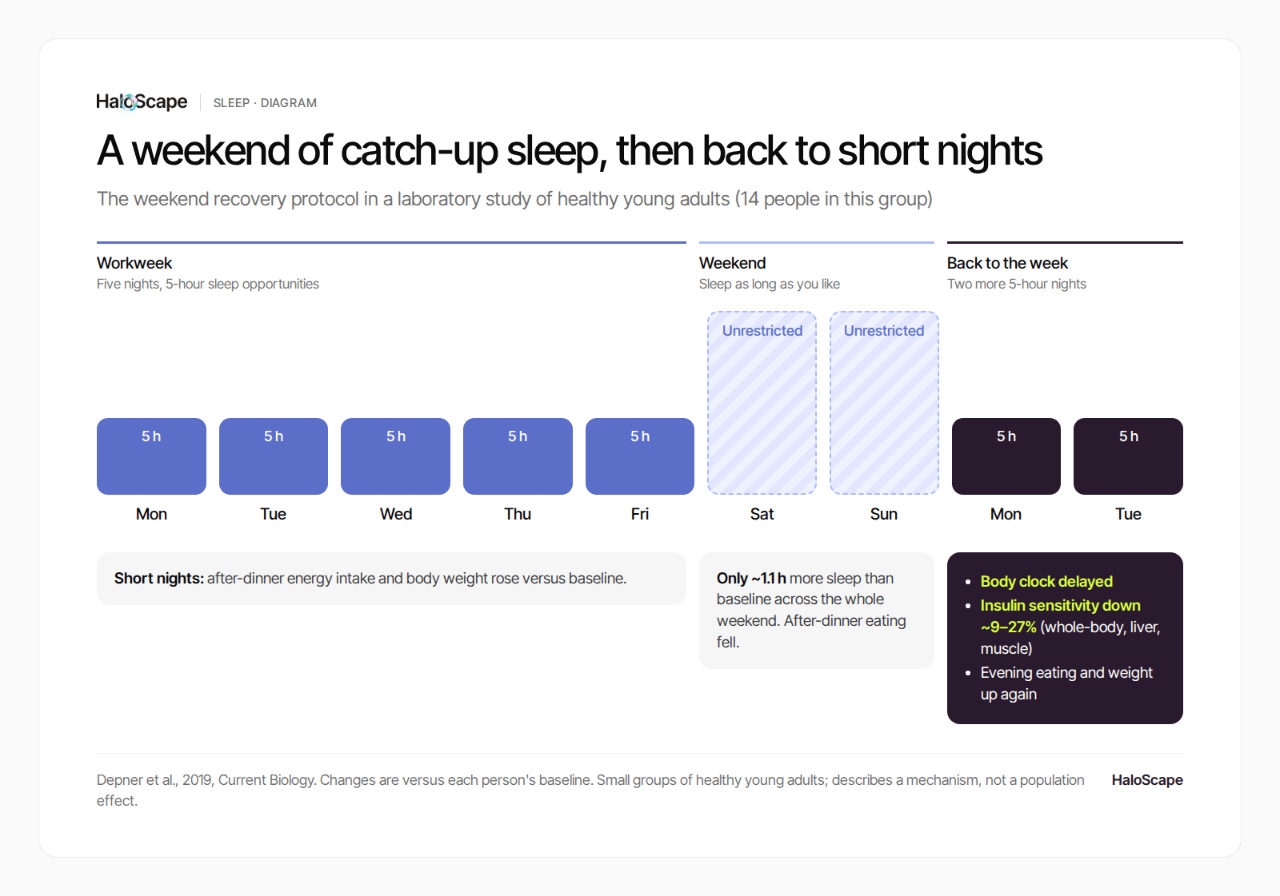
In a laboratory model of weekday restriction with weekend recovery, people slept only about 1.1 hours more than baseline across the weekend, and whole-body, hepatic and muscle insulin sensitivity fell during the short nights that followed.
Sleep debt isn't a bank balance
Sleep debt is usually described like a bank balance: lose four hours across the week, sleep four extra hours on Saturday, settle up. The metaphor is the problem. In practice, the physiology behaves less like an account and more like several separate systems, each with its own rate of return.
The clearest signal that pressure has accumulated is what happens to sleep itself once you are allowed more of it. In nine healthy adults studied through 21 nights of chronic sleep restriction at 5 to 5.6 hours in bed, nightly sleep duration fell by 95.4 ± 21.2 minutes compared with the period before restriction, and during the nine recovery nights that followed it rose by 103.3 ± 23.8 minutes (Xin et al., 2022). Sleep also became deeper and more consolidated during restriction. That isn't an improvement. It's a homeostatic response, the system pulling what it can from a shorter window. The same study found that sustained attention had still not fully recovered after all nine recovery nights.
That gap between how a night looks and what it restores is also one reason a long night can leave you feeling less restored than the clock suggests, covered in Why you can feel tired after eight hours of sleep. I
What comes back after one long night
Here's where the timeline stops cooperating.
Sustained attention is the marker that most consistently fails to come back when people expect it to. In that same study of 83 adults, the group that had been restricted to 4 hours recovered on everything after the first night except lapses and response speed on the Psychomotor Vigilance Test, which had not fully recovered after four nights of 12-hour recovery sleep. In the group that had gone 36 hours without sleep, it was vigor, a self-rated sense of energy, that did not come back.
The dose-response version of the question was tested directly. In an intent-to-treat laboratory study, 159 healthy adults aged 22–45 spent five nights restricted to 4 hours in bed and were then randomized to a single recovery night of 0, 2, 4, 6, 8 or 10 hours in bed (Banks et al., 2010). Deficits improved as the recovery dose rose. But at the largest dose, 10 hours in bed or about 9 hours of actual sleep, vigilance performance, subjective sleepiness and fatigue had still not returned to baseline. Ten hours in bed. One night. Still short.
Why did sleepiness recover after one night in one study and not in the other? The recovery night was longer in the second study, 12 hours in bed against a maximum of 10, and the deficits were tracked across several nights rather than one. Read together, the two studies suggest that how you feel can return after one long night, but only if the night is long enough, and that attention lags behind either way.
Across three laboratory studies, sleepiness and fatigue recovered after one long night in some designs, while sustained attention had not fully recovered after one, four or even nine recovery nights.
What doesn't come back on schedule
If you've ever slept in on a Saturday, felt fine by Sunday and still started Monday with nothing in reserve, you've already met this split without seeing the data behind it. The fastest returns show up in the measures you can feel.
In a laboratory study of 83 adults who underwent either five nights of 4-hour time in bed or 36 hours of total sleep deprivation, followed by four recovery nights at 12 hours in bed, most outcomes recovered after the first recovery night and stayed recovered: cognitive performance on most tasks, self-reported sleepiness, self-reported fatigue and physiological sleepiness on a maintenance of wakefulness test (Yamazaki et al., 2021). One recovery night carried most of the load. That first night was also longer, more efficient and of better quality than the fourth.
The measures that come back fastest are also the ones you have direct access to, which is where the trap sits. Feeling recovered is accurate information about one system and weak information about the others.
What doesn't come back on schedule
Here's where the timeline stops cooperating.
Sustained attention is the marker that most consistently fails to come back when people expect it to. In that same study of 83 adults, the group that had been restricted to 4 hours recovered on everything after the first night except lapses and response speed on the Psychomotor Vigilance Test, which had not fully recovered after four nights of 12-hour recovery sleep. In the group that had gone 36 hours without sleep, it was vigor, a self-rated sense of energy, that did not come back.
The dose-response version of the question was tested directly. In an intent-to-treat laboratory study, 159 healthy adults aged 22–45 spent five nights restricted to 4 hours in bed and were then randomized to a single recovery night of 0, 2, 4, 6, 8 or 10 hours in bed (Banks et al., 2010). Deficits improved as the recovery dose rose. But at the largest dose, 10 hours in bed or about 9 hours of actual sleep, vigilance performance, subjective sleepiness and fatigue had still not returned to baseline. Ten hours in bed. One night. Still short.
Why did sleepiness recover after one night in one study and not in the other? The recovery night was longer in the second study, 12 hours in bed against a maximum of 10, and the deficits were tracked across several nights rather than one. Read together, the two studies suggest that how you feel can return after one long night, but only if the night is long enough, and that attention lags behind either way.
Across three laboratory studies, sleepiness and fatigue recovered after one long night in some designs, while sustained attention had not fully recovered after one, four or even nine recovery nights.
The metabolic side was tested with a protocol built specifically around weekend recovery. Healthy young adults were randomly assigned to a 9-hour control condition, to sleep restriction at 5 hours without weekend recovery, or to a weekend recovery group that had a restricted 5-day workweek, two days of unrestricted weekend sleep, then two more nights of insufficient sleep (Depner et al., 2019). Given the chance, the weekend group slept only about 1.1 hours more than baseline across the whole weekend, well short of what the workweek had taken. In the restriction-only group, whole-body insulin sensitivity fell about 13% versus baseline. In the weekend recovery group, whole-body, hepatic and muscle insulin sensitivity fell about 9% to 27% during the short nights that came after the weekend, and after-dinner energy intake and body weight rose versus baseline. The groups were small, 8 to 14 people per arm, and the participants were healthy and young, so this describes a mechanism rather than a general population effect.
Why weekend recovery sleep isn't the same as a steady schedule
This is where hours stop being the whole story.
Two schedules can contain the same number of hours and produce different physiology, because catch-up sleep changes timing as well as duration. In that weekend recovery protocol, circadian phase was delayed during the short nights after the weekend, so the new week started from a shifted internal clock rather than a neutral one. Extra hours bought by going to bed later and waking later aren't the same hours taken on a stable schedule. For more on that clock, see What Is a Chronotype?
At scale, regularity carries the strongest signal. In 60,977 UK Biobank participants with a mean age of 62.8 ± 7.8 years, Sleep Regularity Index scores were calculated from accelerometer data. Compared with the least regular fifth of participants, the top four regularity quintiles were associated with a 20% to 48% lower risk of all-cause mortality, and regularity was a stronger predictor than sleep duration (Windred et al., 2024). This is an observational cohort of mostly older adults, so it shows an association, not that changing your schedule changes your risk.
Sleep debt gets talked about like a bank balance because that's the vocabulary we have for it, and the vocabulary is where it goes wrong. The body doesn't keep accounts. It runs several repairs at once, on separate clocks, and it settles the ones you can feel first. So the morning after a long recovery night is the least informative moment to check. What's informative is the shape of the days that follow a short week: how quickly resting heart rate and heart rate variability settle back into your own range, and how far your sleep timing drifts between weekdays and weekends. HaloScore reads your sleep against your own baseline range rather than a population target.
References
Xin Q, Yuan RK, Zitting KM, Wang W, Purcell SM, Vujovic N, Ronda JM, Quan SF, Williams JS, Buxton OM, Duffy JF, Czeisler CA. Impact of chronic sleep restriction on sleep continuity, sleep structure, and neurobehavioral performance. Sleep. 2022;45(7):zsac046. PMID: 35218665. doi:10.1093/sleep/zsac046
Yamazaki EM, Antler CA, Lasek CR, Goel N. Residual, differential neurobehavioral deficits linger after multiple recovery nights following chronic sleep restriction or acute total sleep deprivation. Sleep. 2021;44(4):zsaa224. PMID: 33274389. doi:10.1093/sleep/zsaa224
Banks S, Van Dongen HP, Maislin G, Dinges DF. Neurobehavioral dynamics following chronic sleep restriction: dose-response effects of one night for recovery. Sleep. 2010;33(8):1013-26. PMID: 20815182. doi:10.1093/sleep/33.8.1013
Depner CM, Melanson EL, Eckel RH, Snell-Bergeon JK, Perreault L, Bergman BC, Higgins JA, Guerin MK, Stothard ER, Morton SJ, Wright KP Jr. Ad libitum weekend recovery sleep fails to prevent metabolic dysregulation during a repeating pattern of insufficient sleep and weekend recovery sleep. Curr Biol. 2019;29(6):957-967.e4. PMID: 30827911. doi:10.1016/j.cub.2019.01.069
Windred DP, Burns AC, Lane JM, Saxena R, Rutter MK, Cain SW, Phillips AJK. Sleep regularity is a stronger predictor of mortality risk than sleep duration: a prospective cohort study. Sleep. 2024;47(1):zsad253. PMID: 37738616. doi:10.1093/sleep/zsad253