
How Does Exercise Affect Your HRV?
Date Published
Aug 18, 2026Time to Read
7 min
Exercise moves your heart rate variability in two directions on two different clocks. A single session temporarily lowers it as parasympathetic input to the heart withdraws, and that dip can last anywhere from minutes to more than a day, depending mostly on how hard the session was. Over weeks, regular training is associated with higher resting HRV. So the useful question after a workout isn't how far your number fell. It's how fast it came back into your own range.
Key Takeaways
- A drop in HRV after a hard session is the expected signature of a training stimulus, not a sign that something went wrong.
- Across randomized trials in healthy adults, weeks of training are associated with higher resting HRV, so the acute dip and the chronic trend point in opposite directions.
- How many days it takes to return to your usual range carries more information than the depth of any single dip.
What one session costs, and for how long
Heart rate variability describes the changing interval between consecutive beats, and those changes come from autonomic input to the heart. Exercise strips most of the parasympathetic contribution out. As intensity climbs, vagal outflow withdraws, sympathetic drive takes over, and variability collapses toward a nearly metronomic rhythm. Then you stop and the vagal signal comes back. Not instantly. Not evenly either.
This is where most of the confusion after a workout starts.
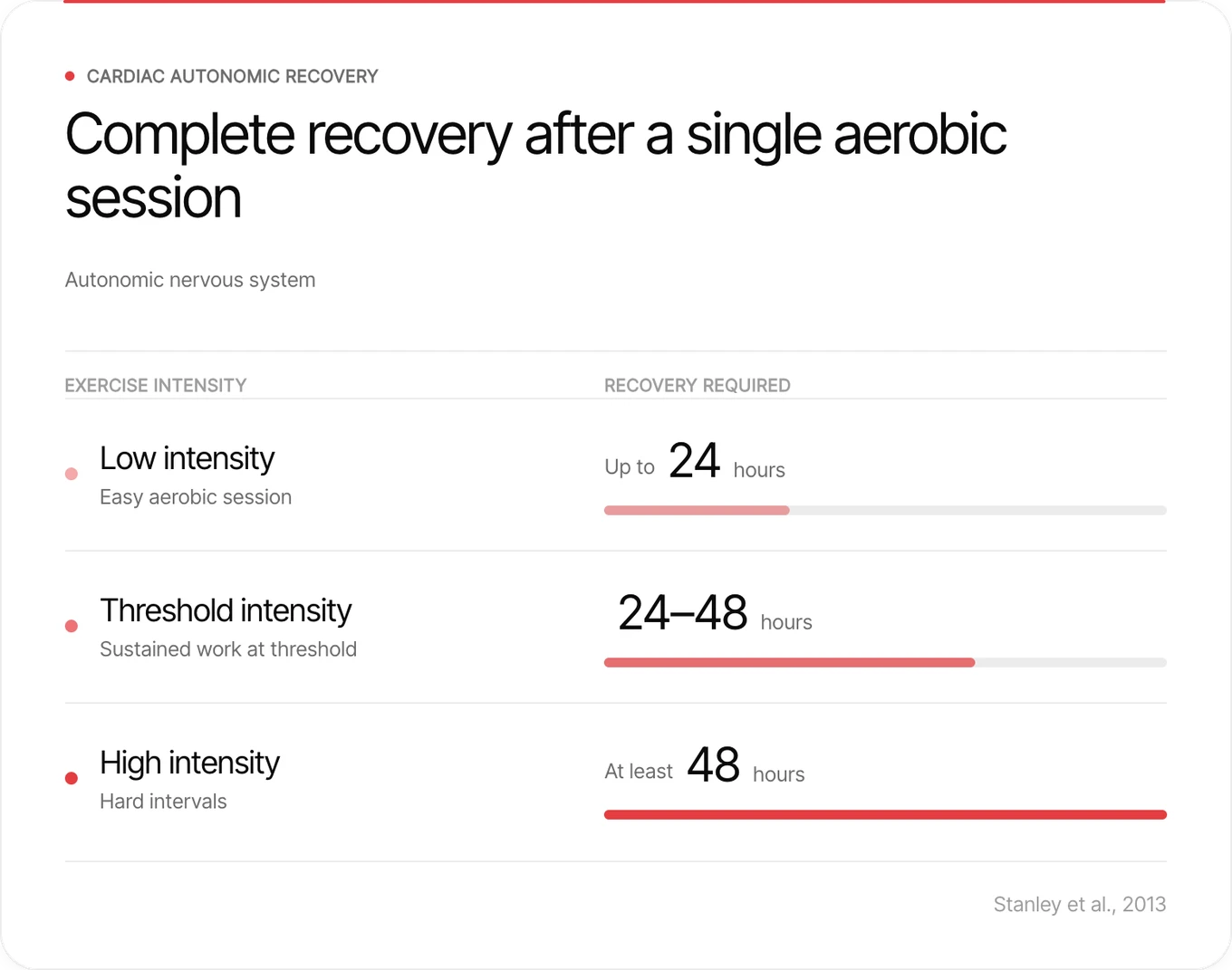
Intensity, not clock time, is the main lever on how long that takes. A quantitative review of post-exercise cardiac parasympathetic reactivation in athletes and healthy individuals found that complete cardiac autonomic recovery after a single aerobic session took up to 24 hours following low intensity exercise, 24–48 hours following threshold intensity exercise, and at least 48 hours following high intensity exercise. On the limited data available, session duration was unlikely to be the greatest determinant (Stanley et al., 2013). So a long easy ride and a short set of hard intervals aren't equivalent autonomic loads. Not even close. And it's the intervals that stay with you into tomorrow.
The window you look at also changes the answer. The first ten minutes after a session and the following night are separate questions, and a spot check taken while you're still catching your breath mostly tells you what you already know: you just trained.
Does regular training lower your HRV?
If you've ever finished a solid block feeling fitter than you've been in years while your nightly numbers looked worse than they'd looked in months, you've had both clocks running at once. The obvious inference from an acute dip is that a heavy training block should grind HRV down over time. Actually, the chronic direction runs the other way.
Pooled results from 16 randomized controlled trials in 623 healthy adults showed that exercise training improved SDNN (SMD 0.58; 95% CI 0.16 to 1.00; p = 0.007), RMSSD (SMD 0.84; 95% CI 0.36 to 1.31; p = 0.0005) and absolute high frequency power (SMD 0.89; 95% CI 0.27 to 1.51; p = 0.005) compared with control. Sex, age and exercise type all moderated the size of the effect (Amekran & El Hangouche, 2024).
Three separate markers. All of them moving up.
So the dip and the trend aren't describing the same thing at all. One is what a session costs. The other is the adaptation those sessions are buying, and it accumulates on a scale of weeks while the cost is settled overnight. Our piece on what recovery actually means physiologically covers why those two clocks run at such different speeds.
Why a heavy week doesn't always land in the number
HRV is a good marker of how far your cardiac autonomic system currently sits from its own resting state. It's a weaker marker of accumulated fatigue than its reputation suggests.
Here's the part that tends to disappoint people.
A systematic review of noninvasive markers of functional overreaching in trained to professional endurance athletes screened 380 articles and included 12. Changes in power output, heart rate including heart rate recovery, rating of perceived exertion and two questionnaire scores reflected functional overreaching, whereas changes in maximal oxygen uptake and heart rate variability parameters did not (Roete et al., 2021). Nocturnal readings don't reliably catch it either. Across 14 days of tracking in 34 high-level female soccer players, training and match workload were not associated with nocturnal HRV (Costa et al., 2021).
Where HRV did separate people was across a block rather than a night. In 24 recreational runners who completed a 3-week baseline, a 2-week overload and a 1-week recovery period, 8 were classified as overreached and 12 as responders based on performance and subjective recovery. The change in nocturnal heart rate (overreached 3.2 ± 3.1%; responders -2.8 ± 3.7%; p = 0.002) and in nocturnal HRV (overreached -0.7 ± 1.8%; responders 2.1 ± 1.6%; p = 0.011) differed between the two groups (Nuuttila et al., 2024). Same prescribed load. Opposite physiological answers.
Which is also why the block that leaves your training partner sharp can leave you flat, and why their numbers aren't a reference for yours. That gap between what a session cost you and what it cost someone else is the same gap we describe in physiological versus perceived stress.
What return time tells you that depth doesn't
This is the part that only works if you've already been collecting nights.
Three things make a post-session HRV reading usable: a personal range built from enough nights that you know how much your readings normally scatter, the intensity of the session that preceded it, and return time. Return time is the number of nights before you sit back inside your band, and it's the closest thing HRV offers to a readout of current capacity. Stress Index reads your nightly window against that range, so a hard session and an easy one become visibly different nights rather than one unexplained number.
Read that way, a low morning after hard intervals is information, not a verdict. Training works by disturbing something and giving the body room to rebuild it, and the dip is the disturbance you went looking for. Nobody reads sore legs on Tuesday as evidence that Monday's squats were a mistake. A flat nightly reading is the same receipt for the same bargain. What deserves a closer look isn't a low number but a low number that stays: one that persists for a week while your training holds steady is a different observation, and a persistent unexplained change belongs in a conversation with a clinician rather than in an app.
Short of that, stop measuring the depth of the dip and start counting nights. How many after an easy session. How many after your hardest. Those two numbers describe your current capacity better than any single morning reading ever will.
References
- Stanley J, Peake JM, Buchheit M. Cardiac parasympathetic reactivation following exercise: implications for training prescription. Sports Medicine. 2013;43(12):1259–1277. PMID: 23912805. doi:10.1007/s40279-013-0083-4 (foundational; no equivalent recent synthesis of recovery kinetics by intensity)
- Amekran Y, El Hangouche AJ. Effects of Exercise Training on Heart Rate Variability in Healthy Adults: A Systematic Review and Meta-analysis of Randomized Controlled Trials. Cureus. 2024;16(6):e62465. PMID: 39015867. doi:10.7759/cureus.62465
- Roete AJ, Elferink-Gemser MT, Otter RTA, Stoter IK, Lamberts RP. A Systematic Review on Markers of Functional Overreaching in Endurance Athletes. International Journal of Sports Physiology and Performance. 2021;16(8):1065–1073. PMID: 34108275. doi:10.1123/ijspp.2021-0024
- Costa JA, Figueiredo P, Nakamura FY, Rebelo A, Brito J. Monitoring Individual Sleep and Nocturnal Heart Rate Variability Indices: The Impact of Training and Match Schedule and Load in High-Level Female Soccer Players. Frontiers in Physiology. 2021;12:678462. PMID: 33981255. doi:10.3389/fphys.2021.678462
- Nuuttila OP, Uusitalo A, Kokkonen VP, Weerarathna N, Kyröläinen H. Monitoring fatigue state with heart rate-based and subjective methods during intensified training in recreational runners. European Journal of Sport Science. 2024;24(7):857–869. PMID: 38956784. doi:10.1002/ejsc.12115
Related reading
- What Is a Good HRV? Why Your Own Range Beats the Chart
There is no single good HRV number. Age, sex and measurement conditions all move it, so what matters is how today sits against your own range.
- What Does Recovery Actually Mean Physiologically?
Recovery is not one process. Neural drive, autonomic balance and fuel stores restore on separate clocks, so a rest day is not a recovered day.
- What Is Zone 2 Training and Why Is Everyone Talking About It?
Zone 2 names a low intensity training range, but percentage based heart rate zones map poorly onto the individual thresholds they are meant to track.